Internal Medicine Study Material for Gulf Licensing Exams
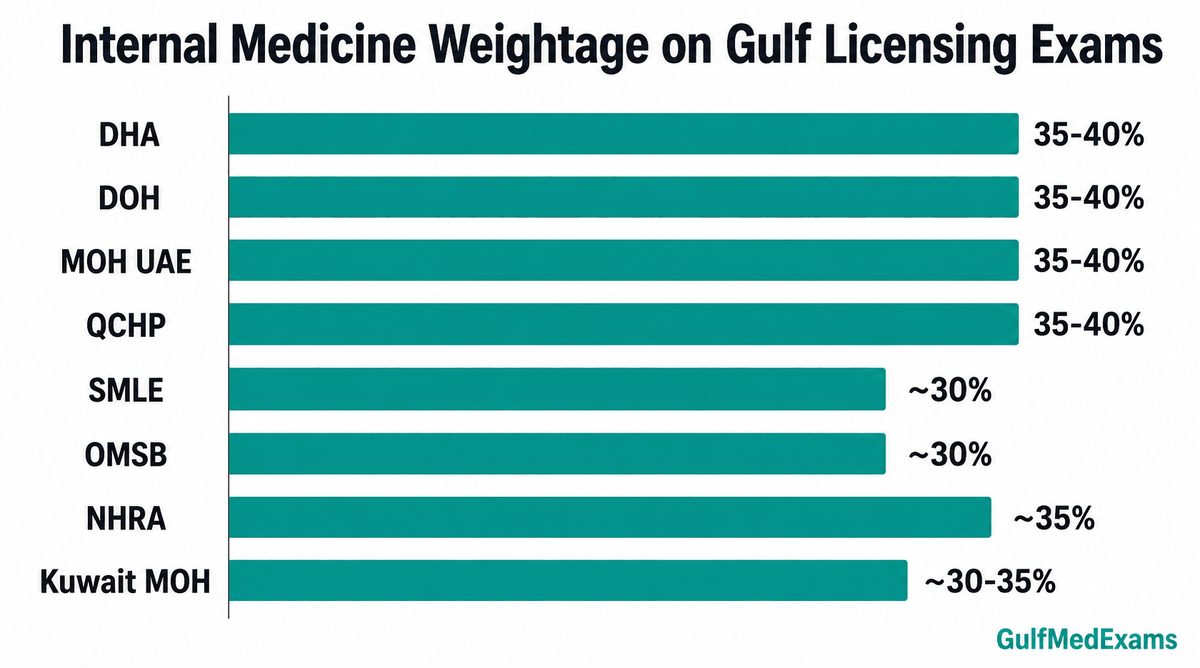
Internal Medicine is the single highest-weighted subject on every major Gulf licensing exam. On the DHA, DOH, MOH UAE, and QCHP exams it typically accounts for 35–40% of questions, and on the SMLE it sits at around 30% with a ±5% cycle-to-cycle variance published by SCFHS. Score well here and you have a decisive margin on the pass threshold; miss this subject and even strong Surgery and Pediatrics scores may not pull you across.
This hub covers 10 sub-specialty study guides across 197 topic pages, each mapped to high-yield exam points that appear on Prometric sittings. Browse the full topic list of any guide without an account, or create a free account to preview the first few pages of each one. Full guide access is part of the GulfMedExams subscription. Pair your reading with recall-verified MCQs to convert it into score-ready recognition.
10 sub-specialty guides
Each guide below has high-yield exam points and common Prometric distractors, ordered by how often the topic appears on recent Gulf exam sittings.
Cardiology
23 pagesThe single highest-yield sub-specialty across every Gulf exam. Expect 8–12 cardiology MCQs on the DHA and 15–20 on the SMLE. Covers acute coronary syndrome, heart failure staging, atrial fibrillation, valvular murmurs, ECG interpretation, and hypertension thresholds.
Read study guidePulmonology
26 pagesSecond-highest-yield medicine sub-specialty. Covers community-acquired pneumonia (CURB-65, IDSA/ATS criteria), COPD exacerbations, asthma stepwise therapy (GINA), pulmonary embolism (Wells, PERC), tuberculosis in Gulf migrant populations, and interstitial lung disease.
Read study guideEndocrinology
19 pagesExtremely high yield given diabetes prevalence in Gulf populations. Covers type 2 diabetes management (ADA targets, SGLT2 inhibitors, GLP-1 agonists), DKA and hyperosmolar hyperglycaemic state, thyroid function interpretation, adrenal insufficiency, and complications screening.
Read study guideGastroenterology
24 pagesCovers upper and lower GI bleeding, peptic ulcer disease and H. pylori eradication, inflammatory bowel disease (Crohn’s vs. ulcerative colitis), viral hepatitis serology, cirrhosis complications, and pancreatitis severity scoring.
Read study guideNephrology
18 pagesCovers acute kidney injury classification (KDIGO), chronic kidney disease staging and referral thresholds, electrolyte disorders, acid-base interpretation, glomerulonephritis patterns, and renal replacement therapy indications.
Read study guideNeurology
19 pagesCovers acute stroke recognition and thrombolysis eligibility (NIHSS, 4.5-hour window), status epilepticus, headache red flags, multiple sclerosis diagnostic criteria, peripheral neuropathy patterns, and dementia differentials.
Read study guideHematology
15 pagesCovers anaemia workup (iron studies, B12, folate patterns), sickle cell crises (high-yield in Gulf regions), thrombocytopenia differentials, coagulation and INR reversal, DVT/PE prophylaxis, and haematological malignancy presentations.
Read study guideRheumatology
32 pagesThe largest sub-specialty by page count. Covers rheumatoid arthritis and DMARD selection, systemic lupus erythematosus (ACR/EULAR criteria), spondyloarthropathies, gout and pseudogout crystal analysis, giant cell arteritis, and vasculitis classification.
Read study guideDermatology
14 pagesCovers eczema and psoriasis stepwise therapy, common skin infections, skin cancer recognition (ABCDE for melanoma), acne management, and Gulf-relevant conditions such as leishmaniasis and heat-related dermatoses.
Read study guideGeneral Internal Medicine
9 pagesCross-cutting topics that do not fit a single sub-specialty: sepsis recognition (qSOFA, SOFA), infective endocarditis (Duke criteria), fever of unknown origin, poisoning and overdose antidotes, geriatric syndromes, and preoperative medical assessment.
Read study guideQuick facts
- Weightage on Gulf exams:
- 30–40% of total questions (highest of any subject)
- Sub-specialties covered:
- 10 — Cardiology, Pulmonology, Nephrology, Endocrinology, Gastroenterology, Neurology, Hematology, Rheumatology, Dermatology, General Internal Medicine
- Total topic pages:
- 197
- Exams covered:
- DHA, SMLE, DOH, MOH UAE, QCHP, OMSB, NHRA, Kuwait MOH
- Recommended MCQ volume:
- 2,500–3,500 medicine-only MCQs before exam day
- Last updated:
How Internal Medicine is weighted on each Gulf exam
Approximate Internal Medicine share of each Gulf licensing exam, based on published blueprints and candidate-reported recalls from 2024–2026 sittings. Weightages fluctuate ±5% per cycle — treat these as planning anchors, not fixed quotas.
| Exam | Medicine % | MCQs | Duration | Notes |
|---|---|---|---|---|
| DHA (Dubai) | 35–40% | 150 | 3 hrs | No negative marking |
| SMLE (Saudi Arabia) | ~30% (±5%) | 200 | 4 hrs | Pass score 560 (scaled, 200–800) |
| DOH (Abu Dhabi) | 35–40% | ~150 | 3 hrs | Formerly HAAD — Pearson VUE delivery |
| MOH UAE | 35–40% | ~150 | 3 hrs | Overlaps heavily with DHA/DOH |
| QCHP (Qatar) | 35–40% | 150 | 3 hrs | Aligned to DHP GP blueprint |
| OMSB (Oman) | ~30% | 150 | 3 hrs | Pearson VUE delivery |
| NHRA (Bahrain) | ~35% | ~150 | 3 hrs | Blueprint by profession category |
| Kuwait MOH (KMLE) | ~30–35% | 100–120 | ~3 hrs | Varies by profession category |
High-yield Internal Medicine topics for Prometric exams
Across the past 24 months of candidate-submitted recalls, these Internal Medicine topics appeared most frequently on Gulf licensing exams. Use this as a triage list when preparation time is limited.
- 1
Acute coronary syndrome
ECG changes, troponin trends, dual antiplatelet therapy, PCI vs. thrombolysis timing
- 2
Type 2 diabetes management
First-line therapy in cardiovascular vs. renal disease, HbA1c targets by comorbidity
- 3
Community-acquired pneumonia
CURB-65 stratification, first-line antibiotics by severity, atypical coverage
- 4
Heart failure
HFrEF vs. HFpEF differentiation, GDMT quadruple therapy (ARNI, beta-blocker, MRA, SGLT2i)
- 5
Atrial fibrillation
Rate vs. rhythm control, CHA₂DS₂-VASc scoring, DOAC selection
- 6
Stroke
Ischaemic vs. haemorrhagic differentiation, thrombolysis eligibility, secondary prevention
- 7
Chronic kidney disease
Staging by eGFR, ACE inhibitor/ARB indications, referral thresholds
- 8
Upper GI bleeding
Glasgow-Blatchford score, PPI dosing, endoscopy timing
- 9
Sepsis
SIRS/qSOFA/SOFA criteria, hour-one bundle, lactate-guided resuscitation
- 10
Anaemia workup
MCV-based differential, iron studies interpretation, transfusion thresholds
Sample Internal Medicine MCQ
Representative of the clinical vignette format used on all Gulf Prometric exams. Attempt it before revealing the explanation.
A 58-year-old man with type 2 diabetes and hypertension presents to the emergency department with 45 minutes of central crushing chest pain radiating to the left arm. Blood pressure is 145/92 mmHg, pulse 96 bpm and regular. ECG shows 2 mm ST-segment elevation in leads II, III and aVF with reciprocal depression in I and aVL. Troponin I is elevated at 0.85 ng/mL (reference <0.04).
Which of the following is the single most appropriate immediate management step?
- A.Oral aspirin 300 mg and refer for outpatient cardiology review within 72 hours
- B.Immediate transfer for primary percutaneous coronary intervention
- C.Intravenous heparin infusion and observe for 24 hours
- D.Sublingual glyceryl trinitrate and repeat troponin in 6 hours
Answer: B. Immediate transfer for primary percutaneous coronary intervention
The vignette describes an inferior ST-elevation myocardial infarction (STEMI) — ST elevation in the inferior leads (II, III, aVF) with reciprocal changes and a positive troponin. Current international guidelines and the DHA/SMLE blueprints support primary PCI as first-line reperfusion when it can be delivered within 120 minutes of first medical contact. Option A delays reperfusion in a time-critical MI. Option C is inappropriate as monotherapy — heparin is an adjunct, not the definitive intervention. Option D targets angina, not an evolving MI with active myocardial necrosis.
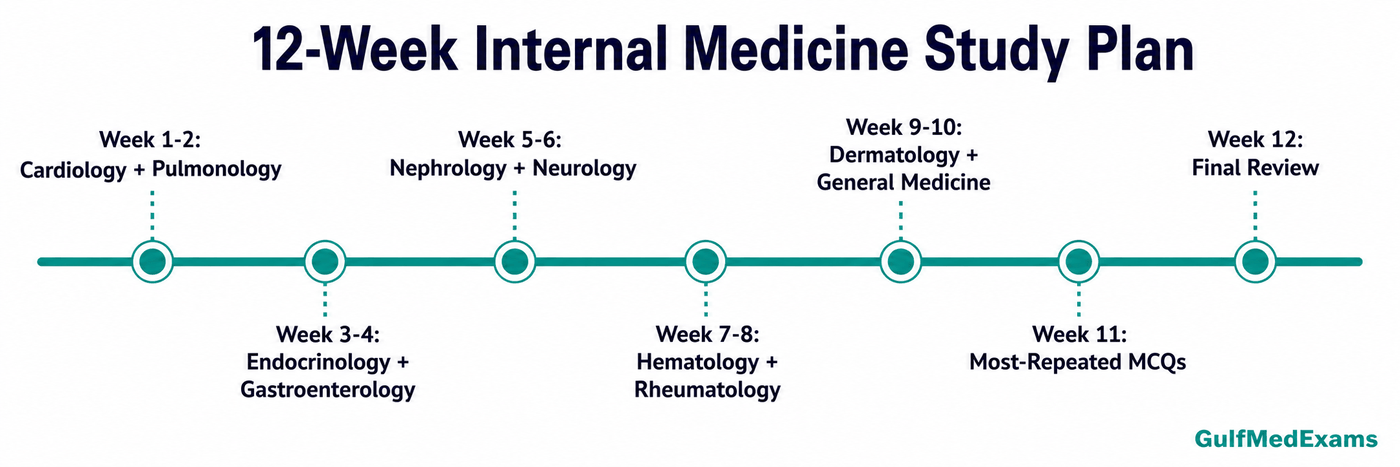
Recommended 12-week Internal Medicine study plan
Designed for a working doctor with 2–3 hours of daily study time, assuming an exam roughly 12 weeks out. Adjust proportionally if your window is shorter or longer.
| Weeks | Focus areas | Daily MCQ target | Deliverable |
|---|---|---|---|
| 1–2 | Cardiology + Pulmonology (highest yield) | 40 MCQs (30 topic + 10 mixed review) | Baseline diagnostic mock score |
| 3–4 | Endocrinology + Gastroenterology | 50 MCQs (35 topic + 15 spaced review) | First subject accuracy > 65% |
| 5–6 | Nephrology + Neurology | 50 MCQs (35 topic + 15 review) | Weakness list refined |
| 7–8 | Hematology + Rheumatology | 50 MCQs (35 topic + 15 review) | Second full-length mock |
| 9–10 | Dermatology + General Internal Medicine + gap topics | 50 MCQs (25 gap + 25 mixed timed) | Sub-specialty accuracy ≥ 70% |
| 11 | Most-repeated MCQs across all Medicine sub-specialties | 60 MCQs timed | Third full-length mock |
| 12 | Weak-area retesting + fresh recall papers | 40 MCQs mixed, no new topics | Exam-ready confidence check |
Candidates who cleared Internal Medicine using this hub
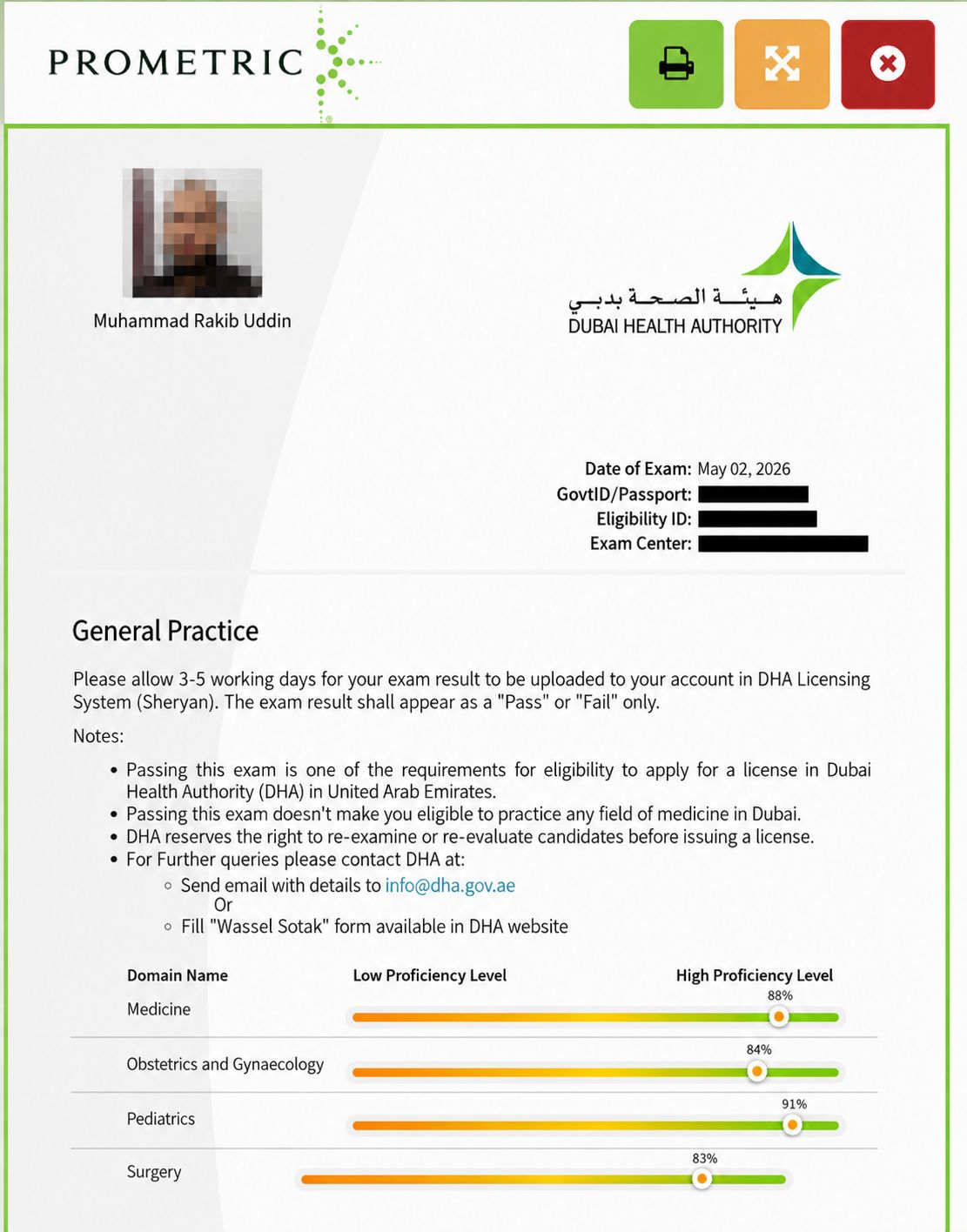
“It's a pleasure for me. I sat the DHA exam last month and, Alhamdulillah, scored 86.5% on my assessment. GulfMedExams helped me tremendously — about 70% of the questions felt familiar from my preparation. I've already recommended this site to many candidates.”
Dr. Rakib Uddin
DHA · 86.5% · Medicine 88%, Pediatrics 91%, OBGYN 84%, Surgery 83% · May 2026
Frequently asked questions about Internal Medicine on Gulf exams
How is Internal Medicine weighted on the DHA exam?
Internal Medicine accounts for 35–40% of DHA exam questions — the highest weighting of any subject. On the 150-question DHA paper, that translates to roughly 52–60 Medicine MCQs. A candidate scoring 70% on Medicine alone will typically be within striking distance of the pass threshold, which is why we recommend allocating at least 40% of study time to this subject.
What Internal Medicine topics repeat most often on the SMLE?
Based on 2024–2026 SMLE recalls submitted by candidates, the most repeated Internal Medicine topics are acute coronary syndrome ECG interpretation, type 2 diabetes management with cardiovascular or renal comorbidity, community-acquired pneumonia severity scoring, heart failure GDMT quadruple therapy, and atrial fibrillation anticoagulation. These five topics alone typically account for 12–15 questions on any given SMLE sitting.
How many Internal Medicine MCQs should I do before the exam?
Target 2,500–3,500 Medicine-specific MCQs before your Prometric sitting. This is the volume most first-attempt passers report and matches roughly 40 MCQs per day over a 12-week preparation window. Quality of review matters more than raw quantity — always read the explanation before moving on, even for questions you answered correctly.
Which Internal Medicine sub-specialty is the highest yield?
Cardiology is the highest-yield sub-specialty on every major Gulf licensing exam, accounting for 25–30% of Internal Medicine questions. Pulmonology and Endocrinology tie for second, each contributing 15–20% of the Medicine block. Prioritise these three sub-specialties in the first four weeks of your study plan.
Are the Internal Medicine study guides updated for 2026?
Yes. The Internal Medicine hub is refreshed regularly, with major updates during active exam windows. Guides are aligned to the current DHA, SMLE, DOH, MOH, QCHP, OMSB, NHRA, and Kuwait MOH blueprints. Look for the last-updated date at the top of each sub-specialty guide.
Can I practice Internal Medicine MCQs by sub-specialty?
Yes. The MCQ bank lets you filter by sub-specialty — Cardiology, Pulmonology, Nephrology, and so on — so you can drill weak areas without wading through unrelated questions. Timed sub-specialty blocks are the fastest way to identify which sub-specialty is dragging your overall Medicine accuracy down.
Do I need a separate Internal Medicine bank for each Gulf exam?
No. Internal Medicine content overlaps 85–90% across the DHA, SMLE, DOH, MOH, QCHP, OMSB, NHRA, and Kuwait MOH exams because they all draw on the same evidence-based clinical guidelines. The GulfMedExams Internal Medicine hub covers all eight exams. Exam-specific differences show up mostly in question style and vignette wording, which you learn to recognise through recall-based MCQ practice.
Is the Internal Medicine content on GulfMedExams free?
The Internal Medicine hub and the topic list for every sub-specialty guide are free to browse without an account. The free tier gives you 100 MCQs and two mini mock exams — the same in every country — so you can test the platform before paying anything. Full guide content and the complete MCQ bank are part of the GulfMedExams subscription, which is priced by region; check the pricing page for the current rate in your country.
How do I combine the study guides with MCQ practice?
Read the study guide for one topic — say, acute coronary syndrome — first. Then immediately attempt 15–20 MCQs on that topic. Review every explanation, correct or not. Return to the study guide 48 hours later to re-read only the sections that matched your wrong answers. This active-recall loop converts passive reading into exam-ready recognition faster than any single-pass study method.
Related resources
Subject hubs
Exam-specific guides
Medical review
Reviewed by: Dr. Mohsin Ali Baloch, MBBS, FCPS (Gastroenterology), SCFHS Senior Registrar — Gastroenterology.
Last updated: .
Review methodology: Study guides are cross-checked against current international clinical guidelines (NICE, AHA/ACC, ADA, KDIGO, GINA), the published exam blueprints of each licensing authority, and candidate-submitted recalls from recent sittings.
Start practising Internal Medicine MCQs
Combine the study guides above with recall-verified MCQs to convert reading into exam-ready recognition. Free preview of every sub-specialty.
Practice Internal Medicine MCQs