General Surgery
13 guides
Acute Abdomen
7 pages
Bowel Obstruction
12 pages
Breast Disorders
17 pages
Colorectal Disorders
22 pages
Hepatobiliary Disorders
19 pages
Hernias
11 pages
Mesenteric Ischemia
12 pages
Pancreatic Disorders
18 pages
Perioperative Care
8 pages
Soft Tissue Infections
6 pages
Thyroid Disorders
16 pages
Trauma
21 pages
Upper Gastrointestinal Disorders
21 pages
General Surgery Study Material for Gulf Licensing Exams
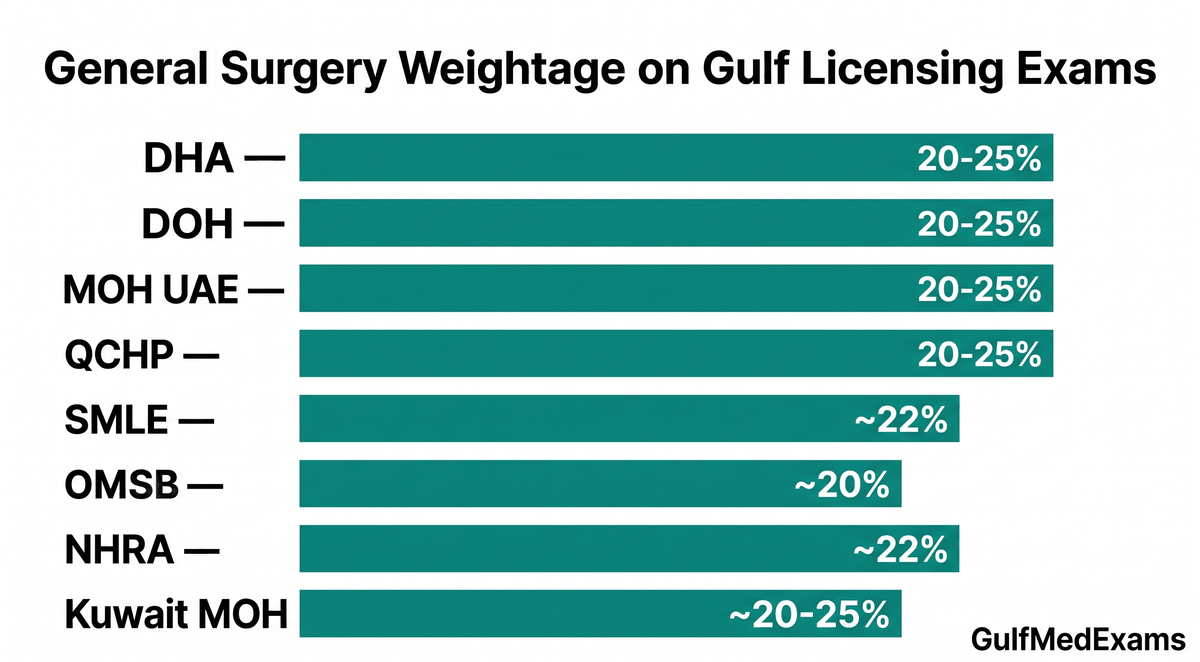
General Surgery accounts for approximately 20–25% of questions on the DHA, DOH, MOH UAE, QCHP, OMSB, NHRA, and Kuwait MOH exams, and around 22% of SMLE questions per the SCFHS blueprint. On a 150-question DHA sitting that translates to 30–38 surgery MCQs; on the 200-question SMLE, expect 40–50. Surgery is the third-highest-weighted subject after Internal Medicine and Pediatrics — but its Prometric long-tail is markedly less contested than either, which makes it one of the faster-ranking hubs in the study material set.
This hub covers 13 sub-specialty study guides across 190 topic pages, each mapped to high-yield exam points that repeat on Prometric sittings. Browse the full topic list of any guide without an account, or create a free account to preview the first few pages of each one. Full guide access is part of the GulfMedExams subscription. Pair your reading with recall-verified MCQs to convert reading into score-ready recognition.
13 sub-specialty guides
Each guide below has high-yield exam points and common Prometric distractors, ordered by how often the topic appears on recent Gulf exam sittings — the first five contribute roughly 60% of all Surgery MCQs.
Trauma
21 pagesThe single highest-yield surgery sub-specialty — expect 6–9 trauma MCQs on DHA and 10–14 on SMLE. Covers ATLS primary and secondary survey, cervical spine clearance, FAST scan indications, damage control resuscitation, massive transfusion protocols, blunt vs. penetrating abdominal trauma, chest trauma, head injury management, and burn resuscitation (Parkland formula).
Read study guideUpper Gastrointestinal Disorders
21 pagesCovers upper GI bleeding (Glasgow-Blatchford, Rockall scores), peptic ulcer perforation and surgical indications, gastric outlet obstruction, GERD and fundoplication indications, hiatal hernias, gastric cancer staging, and bariatric surgery basics.
Read study guideColorectal Disorders
22 pagesThe largest sub-specialty by page count. Covers colorectal cancer screening, Duke's/TNM staging, diverticulitis (Hinchey classification), IBD surgical indications, hemorrhoids and anal fissures, perianal abscess and fistula-in-ano, rectal prolapse, and stoma complications.
Read study guideHepatobiliary Disorders
19 pagesCovers acute cholecystitis (Tokyo guidelines), choledocholithiasis and ERCP indications, cholangitis (Charcot's triad, Reynolds pentad), gallbladder cancer, hepatocellular carcinoma screening, liver abscess, and portal hypertension complications.
Read study guideAcute Abdomen
7 pagesSmall page count but disproportionately high MCQ yield — every Gulf sitting has 4–6 acute abdomen vignettes. Covers appendicitis (Alvarado score, atypical presentations), peritonitis differentiation, pain-quadrant differentials, imaging vs. operate decisions, and pregnancy and elderly acute abdomen.
Read study guidePancreatic Disorders
18 pagesCovers acute pancreatitis (Ranson, APACHE II, BISAP severity scoring), gallstone vs. alcoholic aetiology, pancreatic pseudocyst management, chronic pancreatitis, pancreatic cancer (Whipple procedure indications), and pancreatic neuroendocrine tumours.
Read study guideBowel Obstruction
12 pagesCovers small bowel obstruction (adhesions, hernias, malignancy), large bowel obstruction, sigmoid volvulus (coffee-bean sign), closed-loop obstruction recognition, ileus vs. mechanical obstruction, and when to operate vs. conservative management.
Read study guideBreast Disorders
17 pagesCovers breast cancer screening, triple assessment of a breast lump, DCIS vs. invasive carcinoma, breast cancer surgical management, sentinel node biopsy, benign breast disease, mastitis and breast abscess, and inflammatory breast cancer.
Read study guideThyroid Disorders
16 pagesCovers thyroid nodule workup (Bethesda classification, FNA indications), thyroid cancer differentiation, thyroidectomy indications and complications, Graves' disease surgical options, thyroid storm recognition, and multinodular goitre.
Read study guideHernias
11 pagesCovers inguinal (direct vs. indirect), femoral (higher strangulation risk), umbilical, incisional, ventral, and hiatal hernias, plus hernia complications, open vs. laparoscopic repair, and hernia in cirrhosis and ascites.
Read study guideMesenteric Ischemia
12 pagesCovers acute mesenteric ischemia (embolic, thrombotic, non-occlusive, venous), the classic "pain out of proportion to examination" pattern, CT angiography as first-line imaging, chronic mesenteric ischemia, and mesenteric venous thrombosis.
Read study guidePerioperative Care
8 pagesCovers preoperative assessment (ASA classification), DVT prophylaxis, perioperative antibiotic prophylaxis, postoperative fever workup, postoperative nausea and vomiting, wound infection classification, and ERAS principles.
Read study guideSoft Tissue Infections
6 pagesCovers cellulitis vs. abscess, necrotising fasciitis recognition and LRINEC score, gas gangrene, diabetic foot infections and Wagner classification, animal and human bite management, and Fournier's gangrene.
Read study guideQuick facts
- Weightage on Gulf exams:
- 20–25% of total questions (third-highest after Internal Medicine and Pediatrics)
- Sub-specialties covered:
- 13 — Trauma, Upper GI Disorders, Colorectal, Hepatobiliary, Pancreatic, Acute Abdomen, Bowel Obstruction, Breast Disorders, Thyroid, Hernias, Mesenteric Ischemia, Perioperative Care, Soft Tissue Infections
- Total topic pages:
- 190
- Exams covered:
- DHA, SMLE, DOH, MOH UAE, QCHP, OMSB, NHRA, Kuwait MOH
- Recommended MCQ volume:
- 1,800–2,500 surgery-only MCQs before exam day
- Last updated:
How General Surgery is weighted on each Gulf exam
Approximate General Surgery share of each Gulf licensing exam, based on published blueprints and candidate-reported recalls from 2024–2026 sittings. Weightages fluctuate ±5% per cycle — treat these as planning anchors, not fixed quotas.
| Exam | Surgery % | MCQs | Duration | Notes |
|---|---|---|---|---|
| DHA (Dubai) | 20–25% | 150 | 3 hrs | No negative marking |
| SMLE (Saudi Arabia) | ~22% (±5%) | 200 | 4 hrs | Pass score 560 (scaled, 200–800) |
| DOH (Abu Dhabi) | 20–25% | ~150 | 3 hrs | Formerly HAAD — Pearson VUE delivery |
| MOH UAE | 20–25% | ~150 | 3 hrs | Overlaps heavily with DHA/DOH |
| QCHP (Qatar) | 20–25% | 150 | 3 hrs | Aligned to DHP GP blueprint |
| OMSB (Oman) | ~20% | 150 | 3 hrs | Pearson VUE delivery |
| NHRA (Bahrain) | ~22% | ~150 | 3 hrs | Blueprint by profession category |
| Kuwait MOH (KMLE) | ~20–25% | 100–120 | ~3 hrs | Varies by profession category |
High-yield General Surgery topics for Prometric exams
Across the past 24 months of candidate-submitted recalls, these General Surgery topics appeared most frequently on Gulf licensing exams. Use this as a triage list when preparation time is limited.
- 1
Acute appendicitis
Atypical presentations, Alvarado score, imaging vs. operate
- 2
Small bowel obstruction
Adhesions vs. hernia vs. malignancy, when to operate
- 3
Upper GI bleeding
Glasgow-Blatchford risk stratification, endoscopy timing
- 4
Acute cholecystitis
Tokyo guideline severity, early vs. delayed cholecystectomy
- 5
Acute pancreatitis
Severity scoring (BISAP, APACHE II), fluid resuscitation targets
- 6
Trauma primary survey
ABCDE, C-spine, FAST, blunt vs. penetrating abdomen
- 7
Necrotising fasciitis
Early recognition, LRINEC score, urgent debridement
- 8
Hernia complications
Obstruction vs. strangulation, femoral hernia risk
- 9
Breast lump triple assessment
Mammography, ultrasound, FNA/core biopsy interpretation
- 10
Colorectal cancer
Screening intervals, TNM staging, adjuvant therapy indications
Sample General Surgery MCQ
Representative of the clinical vignette format used on all Gulf Prometric exams. Attempt it before revealing the explanation.
A 62-year-old man presents with 18 hours of colicky central abdominal pain, bilious vomiting, and complete constipation. He had an open appendicectomy 12 years earlier. On examination he is tachycardic (pulse 108 bpm), blood pressure 110/68 mmHg, dehydrated, and his abdomen is distended and tympanic with high-pitched bowel sounds. There is no peritonism. An erect abdominal radiograph shows multiple air-fluid levels in dilated small bowel loops.
Which of the following is the single most appropriate initial management step?
- A.Immediate laparotomy for adhesiolysis
- B.Nasogastric decompression, intravenous fluid resuscitation, and correction of electrolytes
- C.Oral gastrografin and observation
- D.Colonoscopic decompression
Answer: B. Nasogastric decompression, intravenous fluid resuscitation, and correction of electrolytes
This vignette describes uncomplicated adhesive small bowel obstruction — the most common cause in a patient with prior abdominal surgery. In the absence of peritonism, ischaemia, or a closed-loop obstruction, the initial management is conservative: "drip and suck" (IV fluids and NG decompression) alongside electrolyte correction. Roughly 70–80% of adhesive small bowel obstructions resolve without surgery. Option A is reserved for signs of strangulation, closed-loop obstruction, or failure of conservative management after 48–72 hours. Option C (water-soluble contrast challenge) can be both diagnostic and therapeutic but is used after initial resuscitation, not as the first step. Option D is used for sigmoid volvulus, not small bowel obstruction.
Recommended 10-week General Surgery study plan
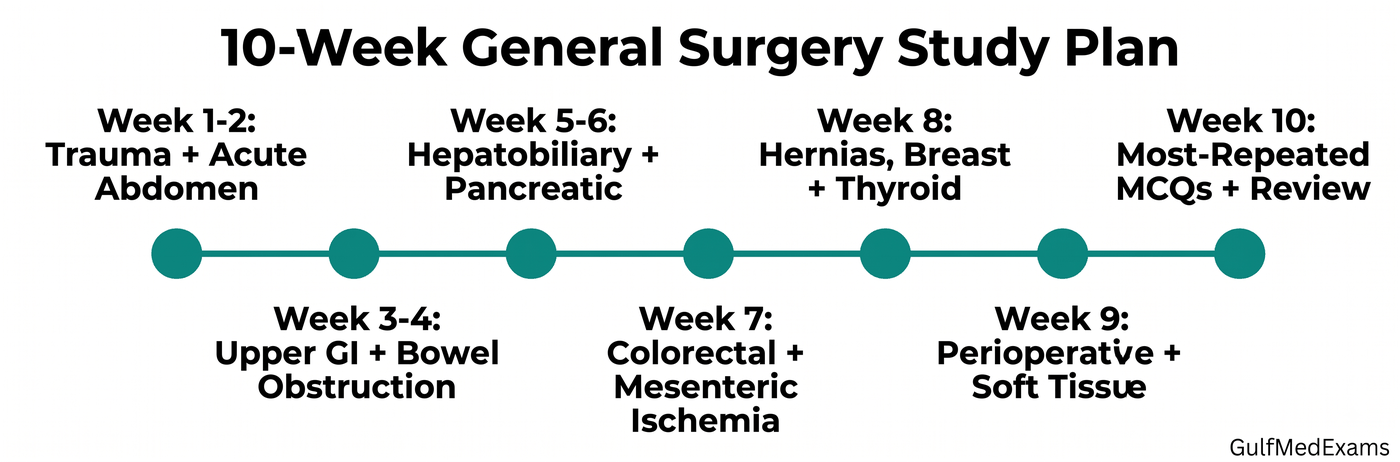
Designed for a working doctor with 2–3 hours of daily study time, assuming an exam roughly 10 weeks out. It clusters sub-specialties by emergency/system-based logic, matching how Gulf exams tend to structure surgical vignettes.
| Weeks | Focus areas | Daily MCQ target | Deliverable |
|---|---|---|---|
| 1–2 | Trauma + Acute Abdomen (highest yield) | 35 MCQs (25 topic + 10 review) | Baseline surgery diagnostic score |
| 3–4 | Upper GI + Bowel Obstruction | 40 MCQs (30 topic + 10 spaced review) | First subject accuracy > 65% |
| 5–6 | Hepatobiliary + Pancreatic Disorders | 40 MCQs (30 topic + 10 review) | Second full-length surgery block |
| 7 | Colorectal + Mesenteric Ischemia | 40 MCQs (30 topic + 10 review) | Weakness list refined |
| 8 | Hernias + Breast Disorders + Thyroid | 40 MCQs (25 topic + 15 timed) | Sub-specialty accuracy ≥ 70% |
| 9 | Perioperative Care + Soft Tissue Infections + gap topics | 40 MCQs (25 topic + 15 review) | Third full-length surgery block |
| 10 | Most-repeated MCQs + weak-area retesting | 50 MCQs timed, no new topics | Exam-ready confidence check |
Candidates who cleared Surgery using this hub
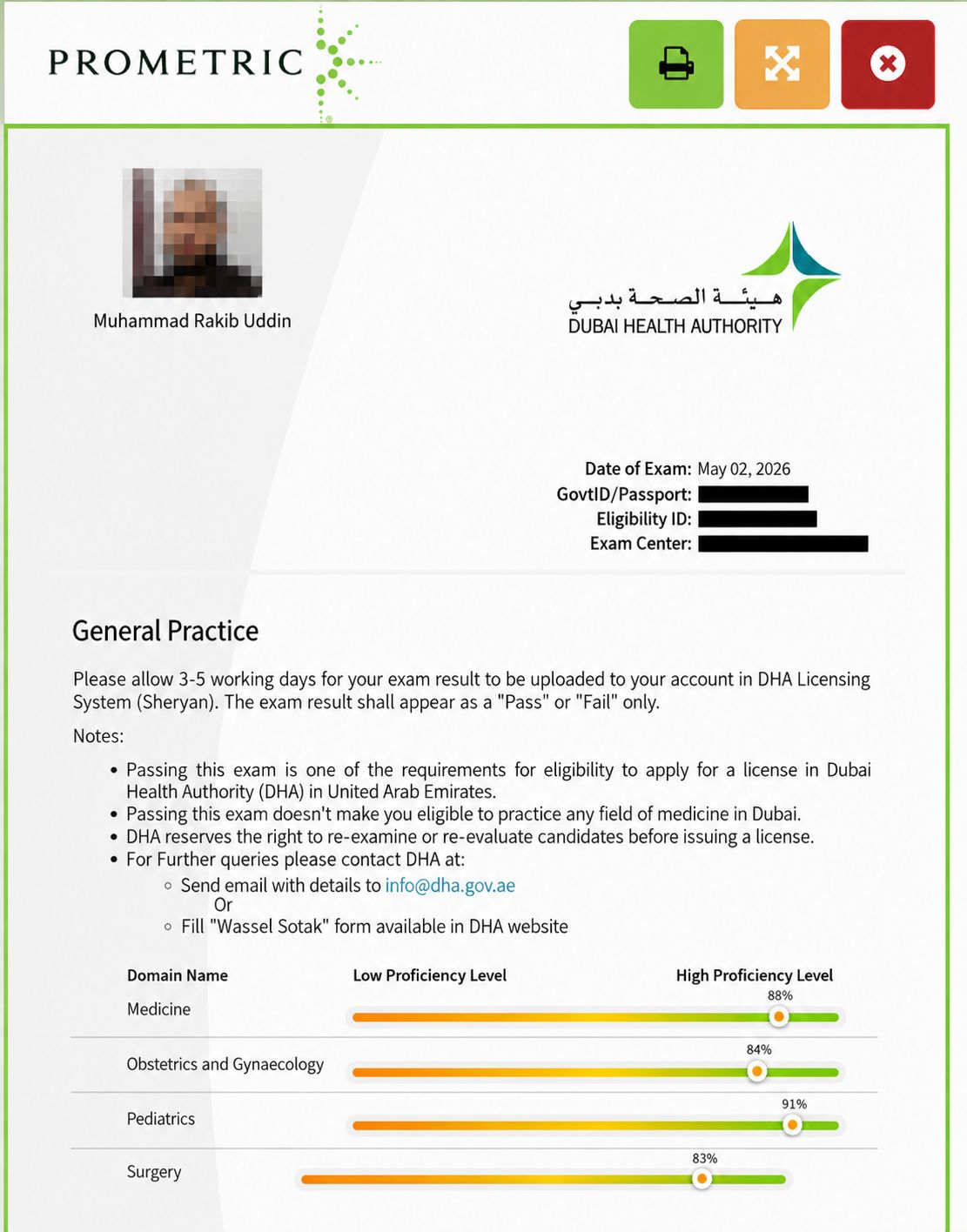
“It's a pleasure for me. I sat the DHA exam last month and, Alhamdulillah, scored 86.5% on my assessment. GulfMedExams helped me tremendously — about 70% of the questions felt familiar from my preparation. I've already recommended this site to many candidates.”
Dr. Rakib Uddin
DHA · 86.5% · Medicine 88%, Pediatrics 91%, OBGYN 84%, Surgery 83% · May 2026
Frequently asked questions about General Surgery on Gulf exams
How is General Surgery weighted on the DHA and SMLE exams?
General Surgery accounts for approximately 20–25% of DHA exam questions and around 22% of SMLE questions (±5% per SCFHS blueprint). On the 150-question DHA paper that translates to roughly 30–38 surgery MCQs; on the 200-question SMLE, expect 40–50. It is the third-highest-weighted subject after Internal Medicine and Pediatrics.
What General Surgery topics repeat most often on Gulf Prometric exams?
Based on 2024–2026 candidate recalls, the most repeated topics are acute appendicitis, small bowel obstruction management, acute cholecystitis, upper GI bleeding, and ATLS trauma primary survey. These five topics alone typically account for 10–14 questions across a full Surgery block on any Gulf licensing exam.
How many General Surgery MCQs should I do before the exam?
Target 1,800–2,500 Surgery-specific MCQs before your Prometric sitting. This is the volume most first-attempt passers report and matches roughly 30 MCQs per day over a 10-week preparation window. Prioritise MCQs on acute presentations — Gulf exams disproportionately test emergency surgery recognition over elective procedure detail.
Which General Surgery sub-specialty is the highest yield?
Trauma is the highest-yield surgical sub-specialty on every Gulf exam, contributing 20–25% of the Surgery block. Upper GI Disorders and Acute Abdomen tie for second, each accounting for 15–18% of surgical questions. Prioritise these three sub-specialties in the first four weeks of your study plan.
Do Gulf exams test operative technique or clinical decision-making?
Gulf licensing exams focus heavily on clinical decision-making — when to operate, when to observe, which imaging to request, and which severity score applies — not on step-by-step operative technique. If a question asks about a procedure, expect it to test the indication, contraindication, or major complication rather than surgical steps.
Can I practice Surgery MCQs by sub-specialty?
Yes. The MCQ bank lets you filter by sub-specialty — Trauma, Upper GI, Colorectal, and so on — so you can drill weak areas without wading through unrelated questions. Timed sub-specialty blocks are the fastest way to identify which sub-specialty is dragging your overall Surgery accuracy down.
Is General Surgery harder for physicians without a surgical rotation?
It can be. Candidates whose internship or house-officer years focused on medical specialties often report Surgery as their second-weakest subject after Pediatrics. The solution is disciplined MCQ practice on emergency presentations — appendicitis, small bowel obstruction, upper GI bleeding, cholecystitis — which together account for a disproportionate share of the exam.
Is the General Surgery content on GulfMedExams free?
The General Surgery hub and the topic list for every sub-specialty guide are free to browse without an account. The free tier gives you 100 MCQs and two mini mock exams — the same in every country — so you can test the platform before paying anything. Full guide content and the complete MCQ bank are part of the GulfMedExams subscription, which is priced by region; check the pricing page for the current rate in your country.
How do I combine the study guides with MCQ practice?
Read the study guide for one topic — say, small bowel obstruction — first. Then immediately attempt 15–20 MCQs on that topic. Review every explanation, correct or not. Return to the study guide 48 hours later to re-read only the sections that matched your wrong answers. This active-recall loop converts passive reading into exam-ready recognition faster than any single-pass study method.
Related resources
Subject hubs
Exam-specific guides
Medical review
Reviewed by: Dr. Mohsin Ali Baloch, MBBS, FCPS (Gastroenterology), SCFHS Senior Registrar — Gastroenterology.
Last updated: .
Review methodology: Study guides are cross-checked against current international clinical guidelines (ATLS, Tokyo, ERAS, SIS, NCCN), regional surgical society recommendations, the published exam blueprints of each licensing authority, and candidate-submitted recalls from recent sittings.
Start practising General Surgery MCQs
Combine the study guides above with recall-verified MCQs to convert reading into exam-ready recognition. Free preview of every sub-specialty.
Practice General Surgery MCQs