Obs & Gynae
10 guides
Cervical Pathology and Prevention
6 pages
Early Pregnancy and Complication & GTD
9 pages
Gynecologic Oncology & Screening
7 pages
Maternal Fetal Medicine & Antenatal Care
7 pages
Menstrual Hormonal & Menopausal Disorders
9 pages
Obstetric Emergencies, Labor & Delivery
13 pages
Pediatric & Adolescent Gynecology
11 pages
PreConception Care Infertility & Family Planning
10 pages
Urogynecology & Breast Health
6 pages
Vulvovaginal Disorders & Gynecologic Infections
5 pages
Obstetrics & Gynecology Study Material for Gulf Licensing Exams
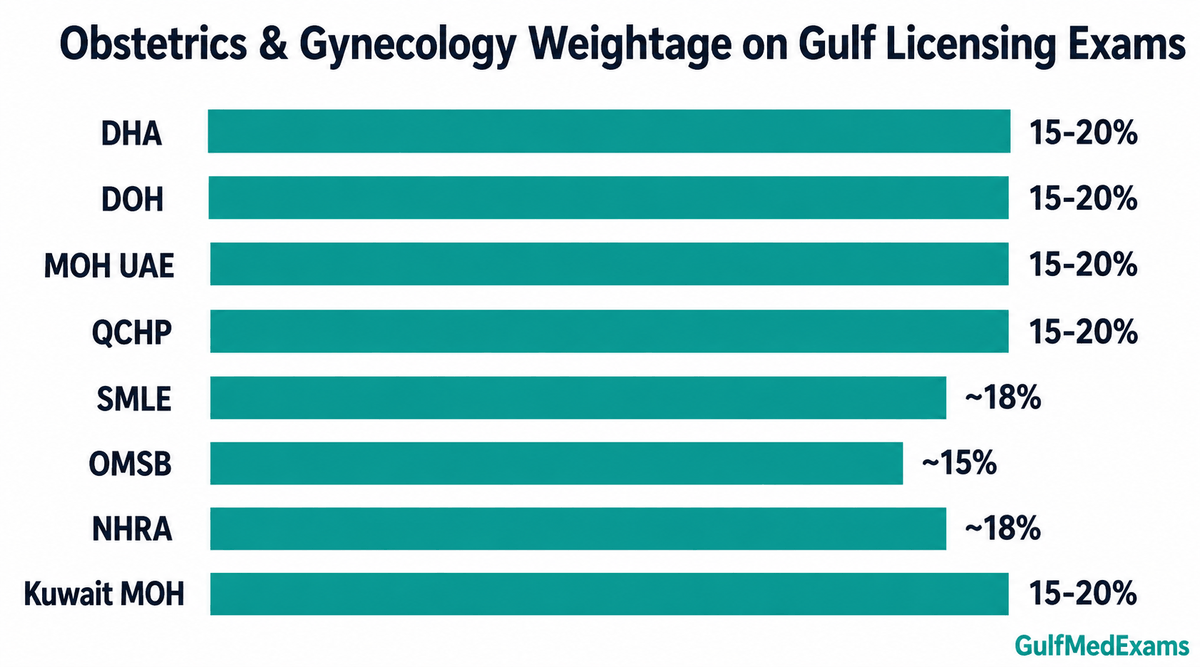
Obstetrics & Gynecology accounts for approximately 15–20% of questions on the DHA, DOH, MOH UAE, QCHP, OMSB, NHRA, and Kuwait MOH exams, and around 18% of SMLE questions per the SCFHS blueprint. On a 150-question DHA sitting that translates to 22–30 OB/GYN MCQs; on the 200-question SMLE, expect around 36. Although it is the fourth-highest-weighted subject, OB/GYN is where under-prepared candidates lose the most marks per question: obstetric emergencies, contraception, and menstrual disorders reward pattern recognition that is hard to reconstruct from first principles under exam pressure.
This hub covers 10 sub-topic study guides across 83 topic pages, each mapped to high-yield exam points that repeat on Prometric sittings. Browse the full topic list of any guide without an account, or create a free account to preview the first few pages of each one. Full guide access is part of the GulfMedExams subscription. Content is aligned to the 2026 blueprints of all eight major Gulf licensing exams and to current RCOG, ACOG, and WHO guidelines.
10 sub-topic guides
Each guide below has high-yield exam points and common Prometric distractors, ordered by how often the topic appears on recent Gulf exam sittings — the first four contribute roughly 60% of all OB/GYN MCQs.
Obstetric Emergencies, Labor & Delivery
13 pagesThe single highest-yield OB/GYN sub-topic on every Gulf exam — expect 5–7 obstetric emergency MCQs on DHA and 8–10 on SMLE. Covers postpartum haemorrhage (four T's, medical management), preeclampsia and eclampsia (severe features, magnesium sulphate), placental abruption vs. praevia, shoulder dystocia (HELPERR), umbilical cord prolapse, uterine rupture, and partogram interpretation.
Read study guideEarly Pregnancy and Complication & GTD
9 pagesCovers ectopic pregnancy (β-hCG discriminatory zone, methotrexate vs. surgical management), miscarriage classification, hyperemesis gravidarum, gestational trophoblastic disease, first-trimester bleeding differentials, and early pregnancy loss counselling.
Read study guidePediatric & Adolescent Gynecology
11 pagesCovers normal pubertal development and Tanner staging, precocious and delayed puberty, primary amenorrhoea in adolescents, adolescent contraception considerations, dysmenorrhoea in adolescents, prepubertal vulvovaginitis, and safeguarding red flags.
Read study guideMaternal Fetal Medicine & Antenatal Care
7 pagesCovers routine antenatal visit schedule, first- and second-trimester screening, gestational diabetes screening and management, pre-existing diabetes in pregnancy, thyroid disorders in pregnancy, TORCH infections, Rhesus isoimmunisation and anti-D prophylaxis, and fetal growth restriction.
Read study guideGynecologic Oncology & Screening
7 pagesCovers endometrial cancer (risk factors, postmenopausal bleeding workup), ovarian cancer (BRCA, CA-125, RMI score), vulval cancer, uterine sarcomas, gestational trophoblastic neoplasia, ovarian mass evaluation (IOTA rules), and germline testing indications.
Read study guideUrogynecology & Breast Health
6 pagesCovers urinary incontinence classification, pelvic organ prolapse (POP-Q staging), overactive bladder, recurrent UTIs in women, breast lump triple assessment, mastitis and breast abscess, benign breast disease, and mammography screening intervals.
Read study guideVulvovaginal Disorders & Gynecologic Infections
5 pagesCovers bacterial vaginosis (Amsel criteria), vulvovaginal candidiasis, trichomoniasis, pelvic inflammatory disease (CDC diagnostic criteria), STI screening, vulval dermatoses, and Bartholin's cyst and abscess management.
Read study guideCervical Pathology and Prevention
6 pagesMenstrual Hormonal & Menopausal Disorders
9 pagesPreConception Care Infertility & Family Planning
10 pagesQuick facts
- Weightage on Gulf exams:
- 15–20% of total questions (fourth-highest after Medicine, Pediatrics, Surgery)
- Sub-topics covered:
- 10 — Obstetric Emergencies & Labor, Early Pregnancy & GTD, Pediatric & Adolescent Gynecology, Preconception & Family Planning, Menstrual & Menopausal Disorders, Maternal Fetal Medicine, Gynecologic Oncology, Cervical Pathology, Urogynecology & Breast Health, Vulvovaginal Disorders
- Total topic pages:
- 83
- Exams covered:
- DHA, SMLE, DOH, MOH UAE, QCHP, OMSB, NHRA, Kuwait MOH
- Recommended MCQ volume:
- 1,500–2,000 OB/GYN-only MCQs before exam day
- Last updated:
How Obstetrics & Gynecology is weighted on each Gulf exam
Approximate OB/GYN share of each Gulf licensing exam, based on published blueprints and candidate-reported recalls from 2024–2026 sittings. Weightages fluctuate ±5% per cycle — treat these as planning anchors, not fixed quotas.
| Exam | OB/GYN % | MCQs | Duration | Notes |
|---|---|---|---|---|
| DHA (Dubai) | 15–20% | 150 | 3 hrs | No negative marking |
| SMLE (Saudi Arabia) | ~18% (±5%) | 200 | 4 hrs | Pass score 560 (scaled, 200–800) |
| DOH (Abu Dhabi) | 15–20% | ~150 | 3 hrs | Formerly HAAD — Pearson VUE delivery |
| MOH UAE | 15–20% | ~150 | 3 hrs | Overlaps heavily with DHA/DOH |
| QCHP (Qatar) | 15–20% | 150 | 3 hrs | Aligned to DHP GP blueprint |
| OMSB (Oman) | ~15% | 150 | 3 hrs | Pearson VUE delivery |
| NHRA (Bahrain) | ~18% | ~150 | 3 hrs | Blueprint by profession category |
| Kuwait MOH (KMLE) | ~15–20% | 100–120 | ~3 hrs | Varies by profession category |
High-yield Obstetrics & Gynecology topics for Prometric exams
Across the past 24 months of candidate-submitted recalls, these OB/GYN topics appeared most frequently on Gulf licensing exams. Use this as a triage list when preparation time is limited.
- 1
Postpartum haemorrhage
Four T's differential, medical vs. surgical management stepwise
- 2
Preeclampsia
Severe feature recognition, magnesium sulphate protocol, delivery timing
- 3
Ectopic pregnancy
β-hCG discriminatory zone, methotrexate criteria, when to operate
- 4
Contraception method selection
WHO MEC categories, method-specific contraindications
- 5
Polycystic ovary syndrome
Rotterdam criteria, insulin resistance, ovulation induction
- 6
Gestational diabetes
Screening thresholds, glucose targets, insulin indications
- 7
Abnormal uterine bleeding
PALM-COEIN, hormonal vs. structural workup
- 8
Pelvic inflammatory disease
CDC diagnostic criteria, empirical antibiotic regimens
- 9
Cervical screening
HPV vaccination, screening intervals, colposcopy referral
- 10
Antenatal screening
First- and second-trimester tests, indications and interpretation
Sample Obstetrics & Gynecology MCQ
Representative of the clinical vignette format used on all Gulf Prometric exams. Attempt it before revealing the explanation.
A 32-year-old woman, gravida 3 para 3, delivers a healthy 3.8 kg baby by spontaneous vaginal delivery after a 4-hour second stage. The placenta is delivered intact 12 minutes later. She then bleeds heavily. Estimated blood loss is 1,200 mL over the next 15 minutes. On examination the uterus is soft and above the umbilicus. Blood pressure is 92/58 mmHg, pulse 116 bpm. IV access is in place and crystalloids have been started.
Which of the following is the single most appropriate immediate next step?
- A.Uterine massage and intramuscular oxytocin 10 units
- B.Manual removal of retained placental fragments in theatre
- C.Immediate transfer to interventional radiology for uterine artery embolisation
- D.Bakri balloon insertion
Answer: A. Uterine massage and intramuscular oxytocin 10 units
The vignette describes primary postpartum haemorrhage due to uterine atony — the most common cause (approximately 70% of PPH cases) and the first "T" of the four T's mnemonic (Tone, Trauma, Tissue, Thrombin). A soft uterus above the umbilicus after delivery is atony until proven otherwise. First-line management is stepwise: uterine massage, oxytocin (10 units IM or IV infusion), then ergometrine, carboprost, and misoprostol as needed. Option B is appropriate if retained tissue is suspected, but the placenta was documented intact. Options C and D are second-line interventions for atony that fails medical management — not the immediate step. The vignette is testing whether you recognise atony and start the medical PPH ladder correctly.
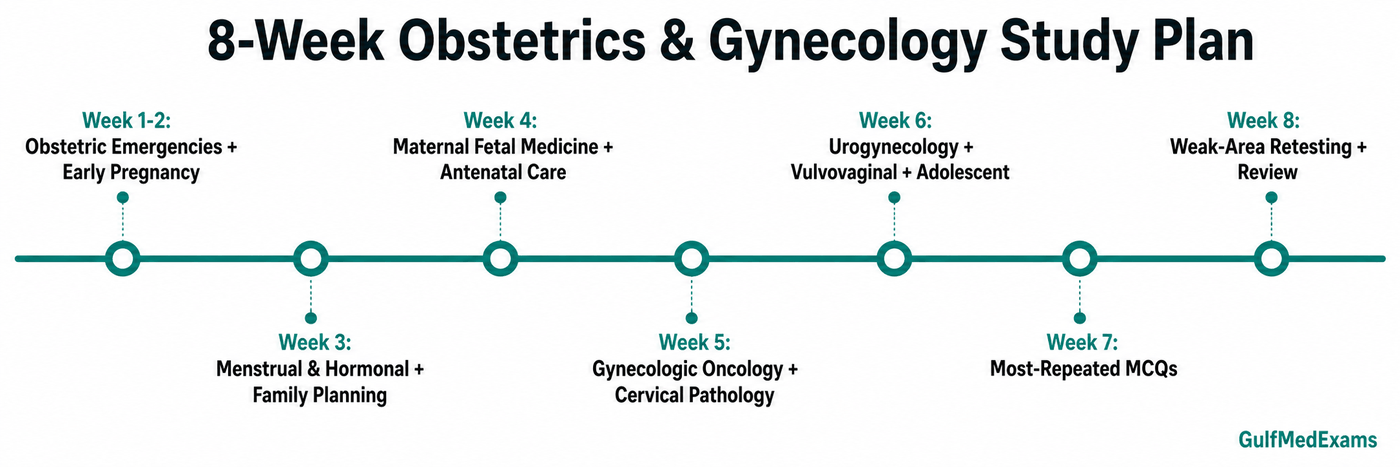
Recommended 8-week Obstetrics & Gynecology study plan
Designed for a working doctor with 2–3 hours of daily study time, assuming an exam roughly 8 weeks out. OB/GYN has fewer sub-topics and less cross-referencing than the other hubs, so it consolidates faster.
| Weeks | Focus areas | Daily MCQ target | Deliverable |
|---|---|---|---|
| 1–2 | Obstetric Emergencies + Early Pregnancy (highest yield) | 30 MCQs (22 topic + 8 review) | Baseline OB/GYN diagnostic score |
| 3 | Menstrual & Hormonal + Preconception & Family Planning | 35 MCQs (26 topic + 9 spaced) | First subject accuracy > 65% |
| 4 | Maternal Fetal Medicine + Antenatal Care | 35 MCQs (25 topic + 10 review) | Second full-length OB/GYN block |
| 5 | Gynecologic Oncology + Cervical Pathology | 35 MCQs (25 topic + 10 review) | Weakness list refined |
| 6 | Urogynecology + Vulvovaginal Disorders + Pediatric/Adolescent Gyn | 35 MCQs (25 topic + 10 review) | Sub-topic accuracy ≥ 70% |
| 7 | Most-repeated MCQs across all OB/GYN sub-topics | 45 MCQs mixed timed | Third full-length OB/GYN block |
| 8 | Weak-area retesting + fresh recall papers | 35 MCQs, no new topics | Exam-ready confidence check |
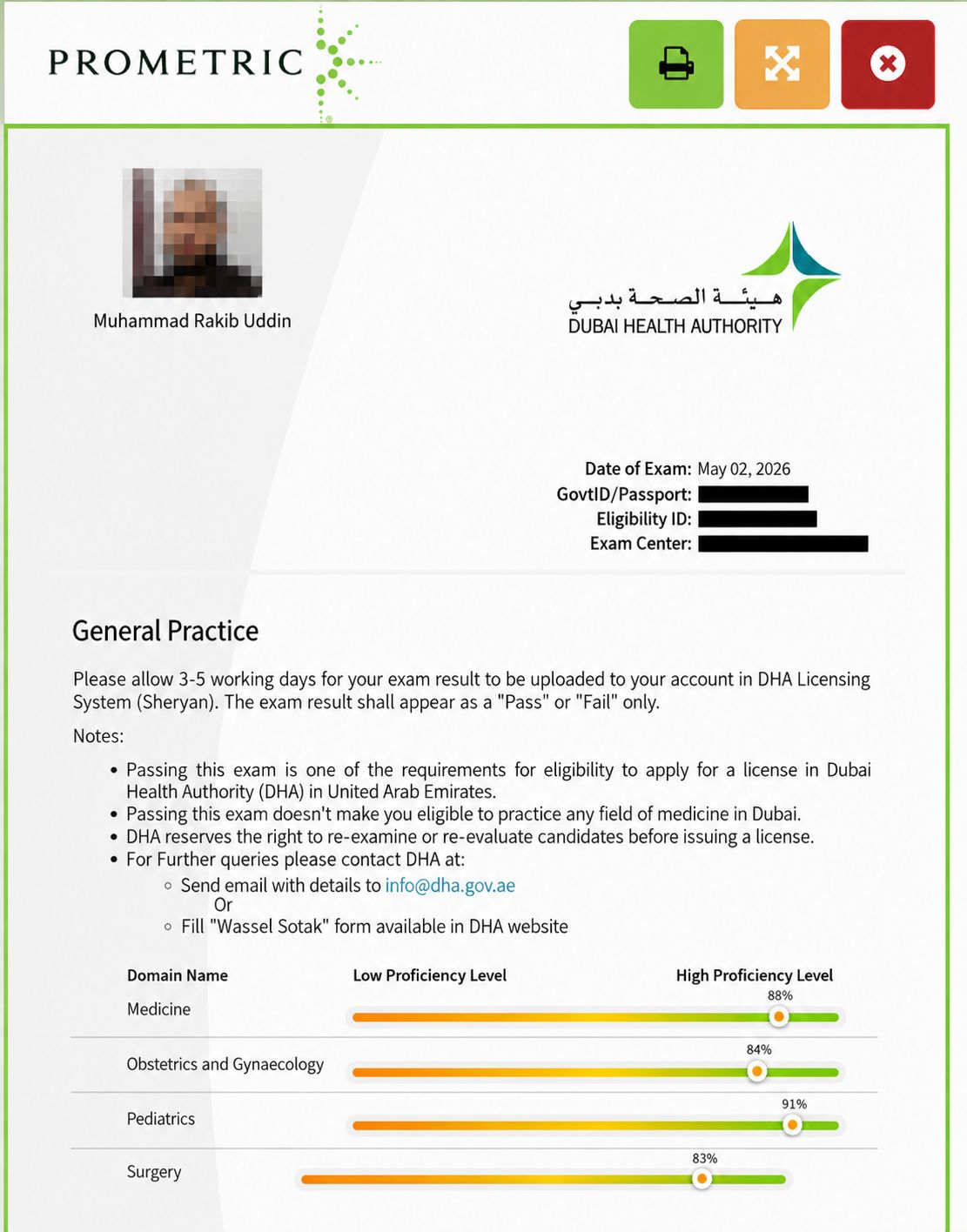
Candidates who cleared OB/GYN using this hub
“It's a pleasure for me. I sat the DHA exam last month and, Alhamdulillah, scored 86.5% on my assessment. GulfMedExams helped me tremendously — about 70% of the questions felt familiar from my preparation. I've already recommended this site to many candidates.”
Dr. Rakib Uddin
DHA · 86.5% · Medicine 88%, Pediatrics 91%, OBGYN 84%, Surgery 83% · May 2026
Frequently asked questions about OB/GYN on Gulf exams
How is Obstetrics & Gynecology weighted on the DHA and SMLE exams?
OB/GYN accounts for approximately 15–20% of DHA exam questions and around 18% of SMLE questions (±5% per SCFHS blueprint). On the 150-question DHA paper that translates to roughly 22–30 OB/GYN MCQs; on the 200-question SMLE, expect around 36. It is the fourth-highest-weighted subject after Internal Medicine, Pediatrics, and General Surgery.
What OB/GYN topics repeat most often on Gulf Prometric exams?
Based on 2024–2026 candidate recalls, the most repeated topics are postpartum haemorrhage management, preeclampsia and eclampsia protocols, ectopic pregnancy workup, contraception method selection (WHO MEC categories), and polycystic ovary syndrome. These five topics alone typically account for 10–14 questions across a full OB/GYN block on any Gulf licensing exam.
How many OB/GYN MCQs should I do before the exam?
Target 1,500–2,000 OB/GYN-specific MCQs before your Prometric sitting. This is the volume most first-attempt passers report and matches roughly 30 MCQs per day over an 8-week preparation window. Emphasise obstetric emergencies — Gulf exams disproportionately test acute presentations over elective gynecology.
Which OB/GYN sub-topic is the highest yield?
Obstetric Emergencies, Labor & Delivery is the highest-yield OB/GYN sub-topic across every Gulf exam, contributing 25–30% of the OB/GYN block. Early Pregnancy and Menstrual/Hormonal Disorders tie for second, each accounting for 12–16% of OB/GYN questions. Prioritise these three sub-topics in the first three weeks of your study plan.
Is OB/GYN harder for candidates without an obstetrics rotation?
Yes, this is one of the most common gaps in Gulf exam preparation — many general practitioners rotated through obstetrics briefly during internship and have not seen high-volume labour ward or postnatal care since. The gap closes reliably with 25–30 daily MCQs focused on obstetric emergencies and stepwise protocols. Pattern recognition — "four T's for PPH", "HELPERR for shoulder dystocia" — is what the exam rewards.
Do the family planning and contraception guides account for Gulf regional context?
Yes. Content is written in clinical, non-partisan language appropriate for candidates practising in any Gulf jurisdiction. Contraceptive method selection follows WHO Medical Eligibility Criteria — the same evidence framework every Gulf exam tests against. Legal, cultural, and religious framing is left to each candidate's own practice context rather than embedded in study material.
Can I practice OB/GYN MCQs by sub-topic?
Yes. The MCQ bank lets you filter by sub-topic — Obstetric Emergencies, Early Pregnancy, Menstrual Disorders, and so on — so you can drill weak areas without wading through unrelated questions. Timed sub-topic blocks are the fastest way to identify which sub-topic is dragging your overall OB/GYN accuracy down.
Is the OB/GYN content on GulfMedExams free?
The OB/GYN hub and the topic list for every sub-topic guide are free to browse without an account. The free tier gives you 100 MCQs and two mini mock exams — the same in every country — so you can test the platform before paying anything. Full guide content and the complete MCQ bank are part of the GulfMedExams subscription, which is priced by region; check the pricing page for the current rate in your country.
How do I combine the study guides with MCQ practice?
Read the study guide for one topic — say, postpartum haemorrhage — first. Then immediately attempt 15–20 MCQs on that topic. Review every explanation, correct or not. Return to the study guide 48 hours later to re-read only the sections that matched your wrong answers. This active-recall loop converts passive reading into exam-ready recognition faster than any single-pass study method.
Related resources
Exam-specific guides
Medical review
Reviewed by: Dr. Mohsin Ali Baloch, MBBS, FCPS (Gastroenterology), SCFHS Senior Registrar — Gastroenterology.
Last updated: .
Review methodology: Study guides are cross-checked against current international clinical guidelines (RCOG, ACOG, FIGO, WHO, NICE), regional practice patterns, the published exam blueprints of each licensing authority, and candidate-submitted recalls from recent sittings.
Start practising OB/GYN MCQs
Combine the study guides above with recall-verified MCQs to convert reading into exam-ready recognition. Free preview of every sub-topic.
Practice OB/GYN MCQs